- Oct 29, 2026
Choosing a power steering pump is not simply a matter of finding a pump that matches your car’s brand. The correct replacement needs to correspond with the vehicle’s model, engine, steering system, mounting arrangement and original specifications. Selecting the wrong pump can lead to poor steering assistance, installation problems or unnecessary replacement costs.
Whether you are replacing a worn pump or sourcing automotive spare parts for a repair, a few checks before ordering can make the process much easier. The right approach is to confirm the vehicle, identify the existing system, verify the pump and then compare suitable replacement options.
Start With the Vehicle, Not the Spare Part
A common mistake when buying a power steering pump is starting with a product search.
Searching for “power steering pump for Mercedes” or “power steering pump for Range Rover” may bring up several options, but the same manufacturer and model can use different components depending on the production year, engine and specification.
Keep these details ready
Before requesting a quotation or placing an order, note:
- Vehicle make and exact model
- Model year
- Engine specification
- Trim or variant
- VIN or chassis number
- Existing pump part number
- Whether the steering system is hydraulic or another configuration
- Front-wheel, rear-wheel or all-wheel-drive configuration where relevant
Providing these details gives a parts supplier a much stronger starting point than the vehicle name alone.
Is the Pump Actually the Problem?
Before ordering a replacement, make sure the symptoms point toward the pump.
A steering system can develop problems for several reasons, and not every steering issue means the power steering pump has failed.
Heavy steering
If the steering suddenly becomes harder to turn, the pump may not be producing sufficient hydraulic assistance. However, low fluid, a belt problem, restricted lines or another steering-system fault can produce similar symptoms.
Whining or unusual noise
A whining sound while turning the steering wheel can sometimes indicate a problem within the power steering system. Low fluid or air entering the system can also contribute to unusual noises.
Fluid leakage
A visible power steering fluid leak should be investigated before replacing components. The leak could originate from the pump, hose, seal, connection or another part of the system.
Inconsistent steering assistance
If steering assistance changes during driving or becomes weaker when manoeuvring, the system should be inspected rather than assuming the pump is automatically responsible.
This distinction is important because replacing a power steering pump will not correct a fault originating elsewhere.
Check the Original Part Number
Once the pump has been identified as the component requiring replacement, the original part number becomes one of the most useful pieces of information.
A part number can help narrow down compatible replacements and distinguish between pumps that may look almost identical.
Why appearance is not enough
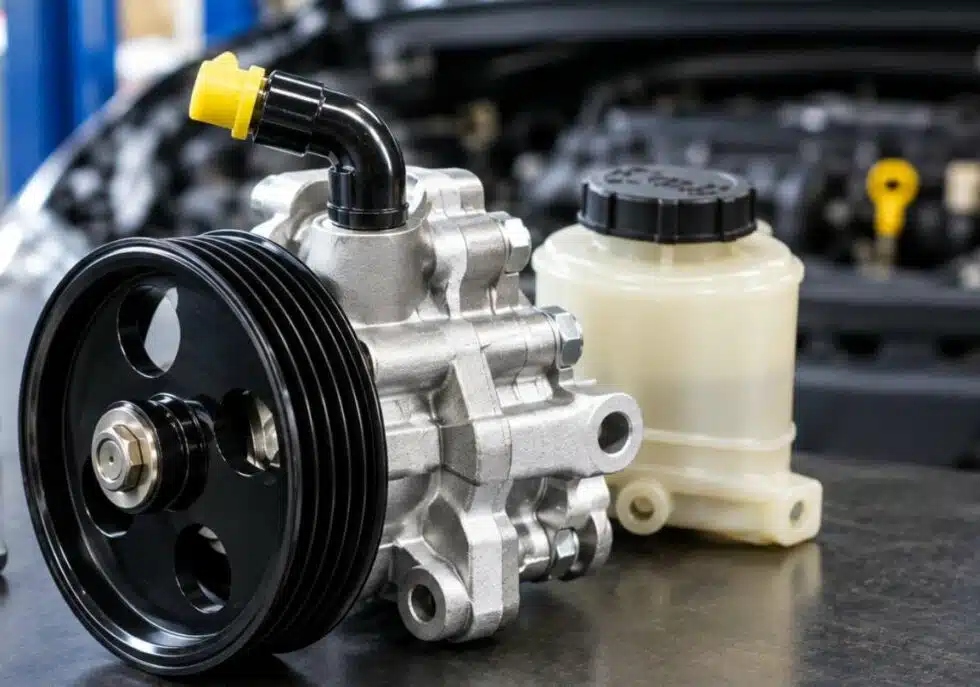
Two power steering pumps can have a similar shape but differ in:
- Mounting points
- Pulley arrangement
- Hose connections
- Pressure specifications
- Shaft configuration
- Reservoir arrangement
- Overall dimensions
For that reason, choosing a pump purely from a photograph is risky.
If the existing part number is readable, provide it to the supplier and ask for compatibility to be confirmed against the vehicle.
Match the Pump to the Steering System
Not every vehicle uses the same type of steering assistance.
Before ordering, determine what steering system your vehicle is equipped with and identify the type of pump it requires.
Hydraulic power steering
Traditional hydraulic systems use a pump to circulate steering fluid and generate hydraulic assistance. The pump is typically driven mechanically by the engine.
Electrically assisted systems
Some modern vehicles use electric assistance rather than a conventional hydraulic pump. In such vehicles, searching for a traditional power steering pump may lead you toward the wrong component entirely.
This is particularly relevant when sourcing parts for newer vehicles, where steering technology can differ significantly between model generations.
Verify Mounting and Connections
Even when the pump is listed for your vehicle, physical compatibility deserves attention.
Mounting points
The replacement needs to attach correctly to the vehicle’s existing mounting arrangement.
Hose connections
The inlet and outlet connections should correspond with the vehicle’s steering system.
Pulley and drive arrangement
For mechanically driven pumps, the pulley and drive arrangement need to match the vehicle’s setup.
Reservoir configuration
Some systems have an integrated reservoir, while others use a separate fluid reservoir.
These details are easy to overlook when ordering online, but they can determine whether a pump is genuinely suitable.
New, Genuine or Aftermarket: What Should You Buy?
Once compatibility has been established, you can compare the type and source of the replacement.
The decision should not begin with the price. First establish which products are technically suitable for the vehicle.
Genuine power steering pumps
A genuine replacement is produced for the manufacturer’s specified vehicle application. This can be an option for owners who prefer parts aligned closely with the original vehicle specification.
Aftermarket power steering pumps
Reputable aftermarket manufacturers produce replacement pumps for many vehicle applications. The important factor is the specific manufacturer’s compatibility information and the quality of the component.
Reconditioned or remanufactured pumps
Depending on the vehicle and market availability, remanufactured components may also be available. If considering this route, ask about the condition, testing process and applicable warranty or replacement terms before purchasing.
The correct choice ultimately depends on the vehicle, repair requirements and buyer’s priorities.
Don’t Forget the Parts Around the Pump
A new pump may not solve the problem if another part of the steering system is causing the failure.
Before installation, it can be useful to inspect:
- Power steering hoses
- Fluid reservoir
- Drive belt
- Belt tensioner where applicable
- Hose connections
- Steering rack
- Seals and fittings
- Fluid condition
Why this matters
If a damaged hose is leaking fluid, installing another pump without fixing the leak can allow the new component to encounter the same problem.
Likewise, if the belt driving the pump is worn or slipping, steering assistance may remain inconsistent even after pump replacement.
A complete system inspection helps prevent repeated repairs.
Use the VIN When the Application Is Unclear
If your vehicle has multiple engine or equipment options, the VIN can be particularly useful.
The VIN allows the parts supplier to work with vehicle-specific information instead of relying only on the model name.
This is especially helpful for premium European vehicles, where several configurations may exist within the same model range.
When ordering online, provide the VIN together with the vehicle model and year whenever possible.
A Practical Buyer’s Checklist
Before confirming your power steering pump order, run through these questions:
Vehicle identification
- Have I provided the exact model?
- Is the model year correct?
- Do I know the engine or variant?
- Can I provide the VIN?
Part identification
- Do I have the existing pump part number?
- Has the replacement number been cross-checked?
- Does the pump match the steering system?
Physical compatibility
- Are the mounting points correct?
- Do the hose connections match?
- Does the pulley or drive arrangement correspond?
- Is the reservoir configuration suitable?
Purchase decision
- Is the part genuine, aftermarket or remanufactured?
- Is the manufacturer clearly identified?
- Are the replacement terms or warranty conditions clear?
- Is the quotation for the exact component rather than a generic model?
This process is more reliable than choosing a pump based only on price or a product photograph.
Common Mistakes to Avoid When Ordering
A few shortcuts can turn a straightforward replacement into an unnecessary return or additional repair.
Ordering by model name alone
A vehicle model can have several power steering configurations. Always provide additional vehicle details.
Choosing the cheapest listing immediately
Price comparison only makes sense after compatible options have been identified.
Assuming every steering noise means pump failure
Noise can have several causes. The system should be checked before buying a replacement.
Ignoring the fluid leak
A leaking hose or connection can continue to affect the steering system even after a new pump is installed.
Forgetting installation requirements
The replacement pump should be installed according to the applicable vehicle and component requirements, including appropriate fluid and system procedures.
Make the Purchase Specific
The most effective way to buy a power steering pump online is to make your enquiry specific from the beginning.
Instead of writing:
“I need a power steering pump for my car.”
provide:
Vehicle: Exact make and model
Year: Production year
Engine: Exact engine specification
Requirement: Power steering pump
VIN: Available
Existing part number: If available
This gives the supplier enough information to begin checking the correct application rather than sending you a long list of potentially unsuitable parts.
Conclusion
A power steering pump is one component within a larger steering system. Its compatibility depends on more than the vehicle badge or model name.
Confirm the vehicle details, check whether the pump is genuinely the source of the problem, compare the original part number and verify mounting and connection specifications. Only after these points are established should you compare genuine, aftermarket or remanufactured options.
For drivers and workshops sourcing power steering pumps and car spare parts in the UAE, Al Khaleej Auto Spares offers genuine and aftermarket automotive components for a range of European, American and Japanese vehicles. Its parts range covers steering, suspension, engine, transmission, electrical and other vehicle systems, with its team available to assist customers in identifying suitable components.
Need to replace a power steering pump? Share your vehicle’s exact model, year, engine specification and VIN or existing part number when requesting a quotation. With the right vehicle information and a properly matched component, you can make the replacement process more accurate, efficient and practical from the start.